
Resisting a Rest or Going to Seed
rethinking our relationship with the natural world

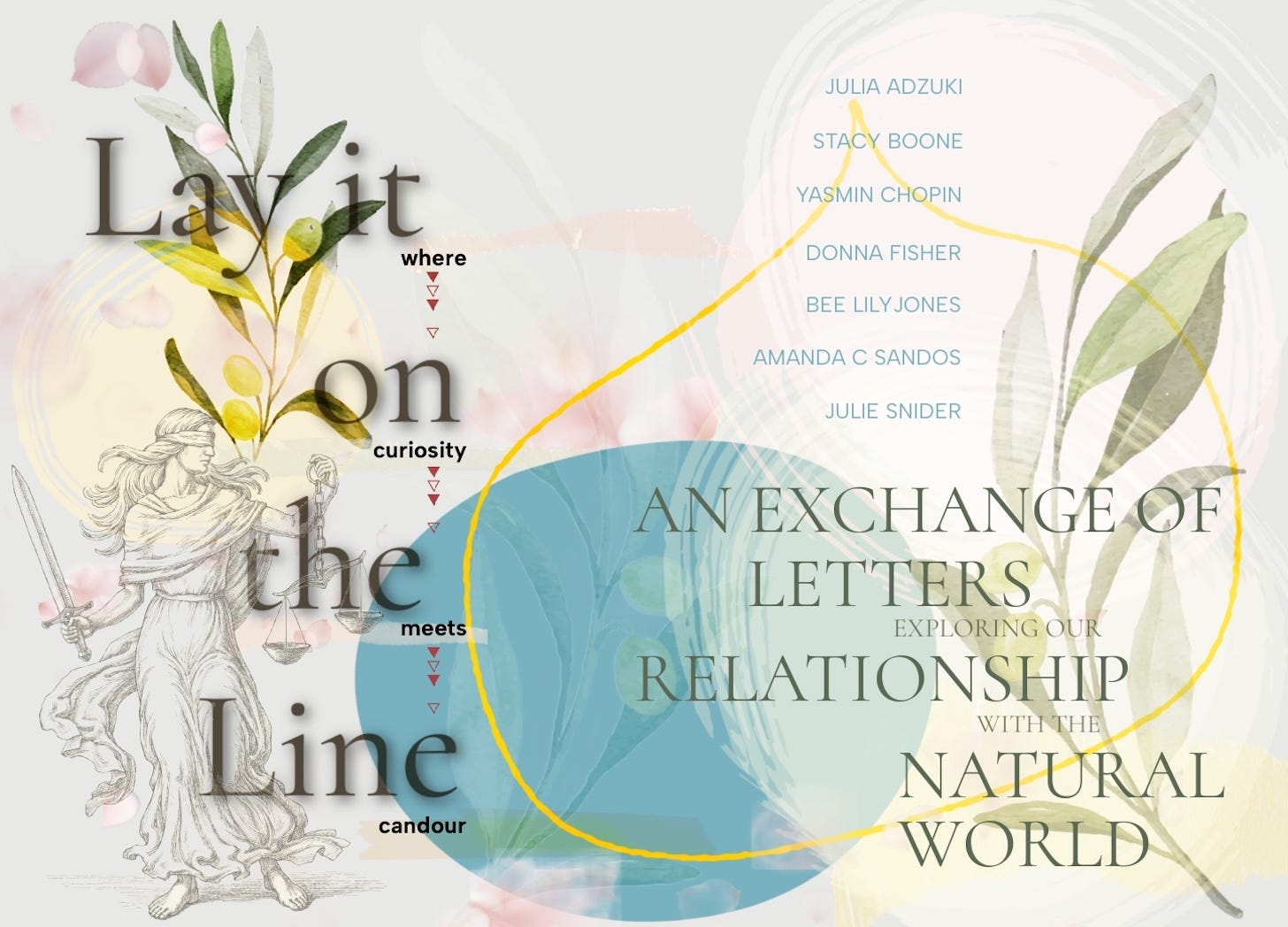
Welcome to Lay it on the Line, a year-long letter exchange between seven writers: Julia Adzuki, Stacy Boone, Yasmin Chopin, Donna Fisher, Bee Lilyjones, Amanda C Sandos and Julie Snider.
Throughout 2026, we’re exploring what it means to rethink our relationship with the natural world. Each month, one of us writes an open letter responding to the previous writer and addressing the next, creating a circular conversation about art, ecology, philosophy and place.
You’re reading Letter #1. Subscribe to follow the conversation as it unfolds.
Dear Stacy,
I’ve been lying on the floor of the yurt for most of the past two days. I took a break from hospital visits to take care of other things, but now I have time the motivation has left me. So I write to you instead, from the surrender of rest.
I wonder, do you think plants struggle with going to seed? Might they fight the phase of decomposition? Or do you suppose they go gracefully, effortlessly yielding to death, rest and renewal?
Despite being a freelance artist, living off-grid in the forest, I find it a struggle to extract myself from extractivist culture. It really has its claws in. This pull to be productive, to resist the urge to rest until, by collapse or illness, there is no choice. This very human predicament seems to have the scent of the market internalised. A heavy handed work ethic that is hard to shake, like cows lining up on the clock at the dairy, even when it’s a surefire road to the growing epidemic of individual and ecological burnout.
An undercurrent in all of this is the undeniable pulse of life to further life, to survive and be survived. This winter, my efforts have been paired back to survival; the wood and water carrying, fire making, snow shovelling, caring for Patrick and fundraising. Writing and running have become essential tools for mental health. Local and far away community has held me in a loving web that makes all of this make sense, in the ebb and flow of the pulse. Still at times, I’ve been toeing the line of doing far too much and sleeping far too little, contrary to winter’s suggestion.
I wonder, how is your relation to rest? With the endless lists of things to do living on the homestead, do you find you can follow the flow of the natural world? Or does market pressure still catch you in its talons?
What strikes me as the most significant difference between extractivist and cyclical culture, is the broken link of rest and renewal. Skipping this step makes the market untenable for life, for cyclic beings, humans included, as part of a cyclical living earth. It imposes an endless reaping and raping of supposedly infinite resources. In the life of a plant, of let’s say a pumpkin (the soup I am cooking tonight), seeds ripen in the fruit and the rest of the plant decomposes, becoming life giving compost. In this case, I collect the seeds and let them rest till the soil is warm enough to plant. Or, they might rest in the ground and sprout in the spring, if the conditions were right and if they were not all eaten by mice (that ate their fair share of potatoes in our cellar).
My point is this - resisting arrest might be a crime in a court of law, but resisting a rest is surely against the laws of the natural world.
I’ve done a lot of unwork over the years in an attempt to shake this off, but can any being be truly free from this system? It’s ghosts and algorithms are getting all the more hungry, this beast knows only growth; snatching time and prodding us on, patenting life and extracting profit in ever more cunning ways. Getting away with it too, even when we know clear as day the damage it is causing. So how the hell can we let this beast go to seed? To not propagate its spore, but instead let it all decompose in a hot compost that truly transforms. How can we turn it into nourishment for life? To connect it again with the missing link of rest and renewal.
What if each of us humans is carrying the very seeds of this beast? What if we stopped feeding it? If we all divested our attention and funds away from billionaires and multinational corporations. What if we successfully composted the greed and power that has persistently cut this sacred loop. Imagine our communities growing so strong that they can resist being clear-felled by the corporate dictates of individualism?
Now I am full swing into my rant… the spring sun and full moon have found me and spur me on!
When I lay in the dark cave of the yurt, I feel like a seed in the ground, waiting. Waiting but not ready to burst into action yet. Just resting, giving into the pause. Perhaps it’s the most natural thing we can do. To rest like the seed, with all potential embodied in stillness. Waiting for the moment, the season, for just enough of the right conditions to burst, but not waiting so long that we rot.
As the snow now softens, I can almost feel my seed coat swell and crack open…
I think the greatest change we can make in our relationship with the natural world, is to shift our culture to a cyclical one. Moving to the forest, this was one of my main motivations. I’m thinking a lot these days about how to sustain our lives and the life of our community, more-than-humans included. I’m thinking a lot about rest and seeds, about the correlation between our cultural lack of rest and relative lack of seed saving. I wonder, do you save your own seeds? Are you planning your garden now or perhaps even beginning to propagate seeds indoors?
Till now, I’ve been a fairly lousy seed saver. My collection of envelopes and various improvised pockets of seeds are barely labelled. They are more likely to note the person I received the plant or seeds from than any great detail of the actual species. Though I have an intention to dive deeper into the process of saving seeds this year, inspired by and learning from my friend and collaborator Aleksa. Our organisation, ARTISTS in RESONANCE, is now planning to start a community seed bank. We plan to bank not only seeds but also nervous system health, by bringing somatic movement and seed saving practices together. A relational art and life project, joining the dots between the rest and renewal of our bodies and food systems.
I’m sensing the emergence of a radicle and plumule - root and shoot are growing…
I’ve only recently learnt just how far off Sweden is from being self-sufficient in seed stock. According to the World Bank, seeds to the value of 114 098 000 USD were imported into Sweden in 2023 alone. This says a lot about how extremely fragile our food systems are. All it would take is the inability to import seeds and food for one season and much of the country would starve. The other factor with importing seeds, is that they are not locally adapted.
As if this wasn’t enough, at the moment, under the smokescreen of wars and scandals, the EU parliament is preparing to pass new laws to deregulate genetically modified organisms. A significant decision that will affect biodiversity, human health and future food sovereignty. The total bollocks claim is that genetically modified organisms, also known as new genomic techniques (GMOs/NGTs), will in some way ensure food security. The primary agenda of GMO companies and lobbyists however, by virtue of them being multinational corporations, is to patent seeds, make money and serve their shareholders. Making farmers (and consumers) contractually obligated to continue buying seeds from these companies, as saving these seeds is illegal (and they are hybrids, so saved seeds do not grow the same). Genetically modified plants can also cross pollinate with non-GMO plants, so without proper regulation we are walking blindly into a circus of Frankenseeds, obliterating a whole lot of biodiversity in the process. (There is a petition if you wish to sign).
Perhaps I’m ready to emerge above the soil surface…
In ancient cultures seeds were used as currency; Aztecs and Mayans used cacao beans, in Japan the Döjima Rice Exchange is considered a forerunner to the modern banking system. Perhaps seeds will re-emerge as currency again in the future. Seed banks are essential for food security and future cultural stability. The question is who controls them, and in what interest. In times of war, seed banks are often targets, in times of ecological instability they are more necessary than ever. ARTISTS in RESONANCE wants to make a Seed Sanctuary, to reimagine the currency of seeds with the interests of community, of life furthering life without greed. To cultivate a genetic diversity of seeds, of plants that are adapted to place and particular conditions, that can survive drier summers, or sudden flooding. Without the interference of Big Ag business.
A very first flower on this early spring day…
Our writing group feels a lot like seed sharing, feeding us all with a genetic diversity of ideas and experiences that not only enrich but regenerate. I had no clue when we first came together to write one year ago just how much life was about to change. You’ve all been such an enormous support to Patrick and I, in his slow recovery from TBE. Although we’ve never even met face to face via screens, the strength of these connections through the words we share is an absolute treasure.
I am wishing you a most abundant garden and looking forward to follow the threads of your thoughts in the next letter exchange.
With love
Julia
Join the discussion! Do you save seeds or have thoughts to share about rest and renewal? Are you grappling with the talons of extractivism or found a way to slip out of its grip? Are you currently rethinking your relationship with the natural world? We’d love to hear from you!